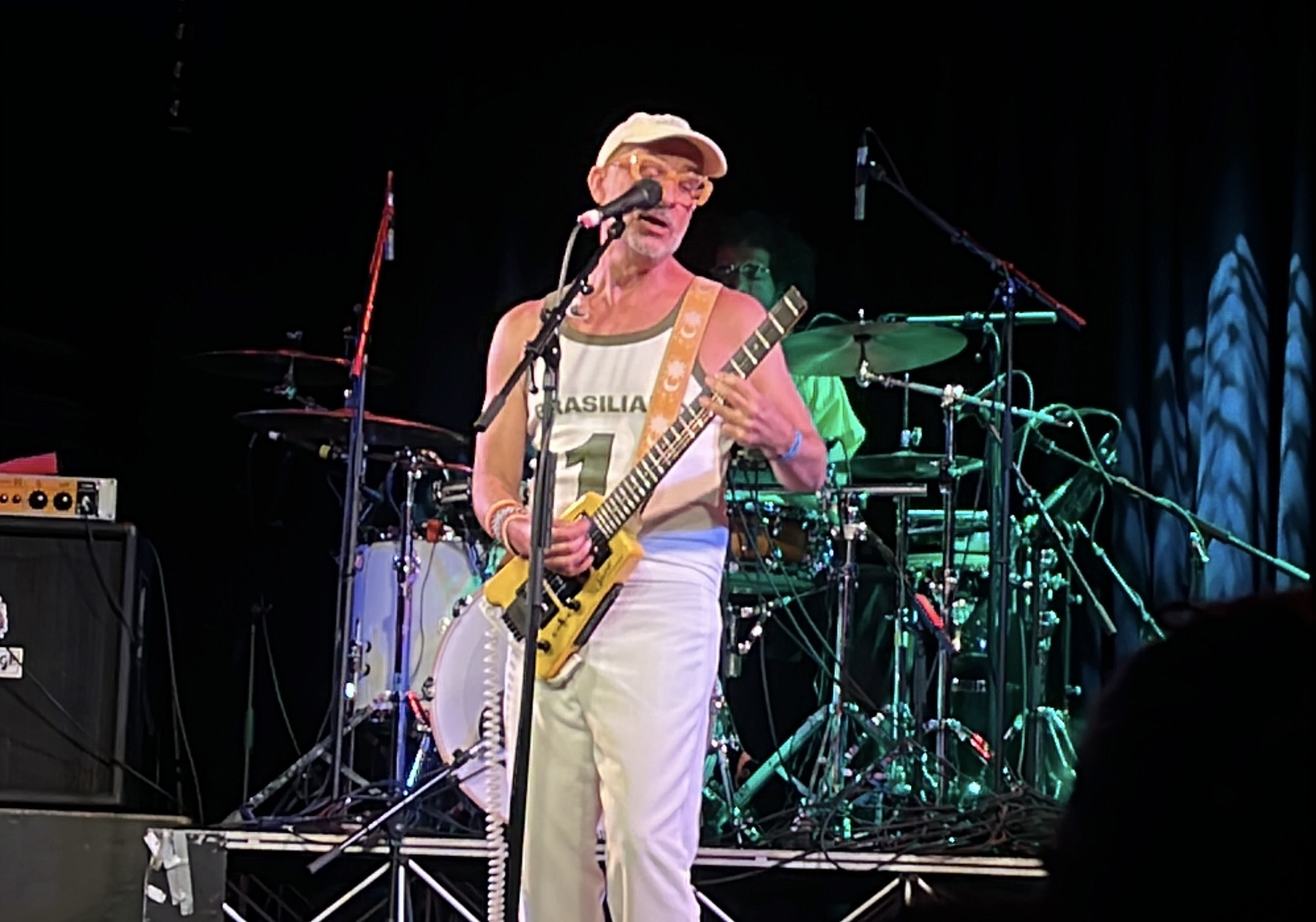
Bringing a melting pot of north-eastern Brazilian rhythms, seasoned with a touch of reggae, Lucas Santtana had the entire audience dancing from start to finish, proof that music always speaks first to the body, regardless of the language the listener speaks.
That said, Lucas Santtana is the kind of songwriter who values the chords of his songs as much as the lyrics. He also cares deeply about politics, and his political views cannot be separated from his artistic expression. One of the songs played at the gig, Meu Primeiro Amor (My First Love), tells the story of a marriage between a middle-class girl from São Paulo and a poor boy from the Brazilian backlands, and it explicitly suggests that this kind of union is now possible largely thanks to Lula da Silva's social policies, which gave resources, hope and self-esteem to historically neglected parts of Brazil.
Another song, A História da Nossa Língua (The History of Our Language), is a love letter to the indigenous and African words, cadences and rhythms that shaped our mother tongue, making it something quite distinct from European Portuguese. On this basis, Lucas Santtana argued that in Brazil we do not speak Portuguese, we speak Brazilian. At this point, an elderly man with long white hair and a suit approached the stage and began gesticulating forcefully at the musician. The artist engaged with him for a few minutes, and the tension in the room was palpable. Eventually, Santtana said: "What they speak in the US is not my problem. I'm talking about my country, my language."
After the gig, I sought out the old man to hear his side. He turned out to be an affronted Portuguese audience member: "If they speak English in the US and nobody makes a fuss," he told me, "why is he saying they don't speak Portuguese in Brazil? Of course they do. He's a musician, not a politician. He should just sing." I thanked him, already knowing he would be the perfect counterpoint to this review.
Whether what is spoken in Brazil is Portuguese or Brazilian is, of course, an open question. But for a Portuguese person to feel entitled to interrupt a Brazilian artist's show in order to lecture him on the name of his own language is deeply symbolic of a colonial mentality that still considers itself superior, and is therefore perplexed and offended by the insubmissive creativity of the formerly colonised.
It is, moreover, not uncommon to hear Portuguese people accusing Brazilians of not speaking Portuguese properly, which is, ironically, an argument in Santtana's favour: if it is true that we don't speak Portuguese well, then we speak Brazilian very well indeed, a kind of Portuguese dough, seasoned with African and indigenous languages absent from the European matrix.
Lucas Santtana, by the way, is not alone. He belongs to a tradition of artists who do not ask permission to sing about politics. If Chico Buarque comes to mind as a Brazilian reference, Fela Kuti is the international epitome of this kind of artist. If, in the same evening, he gets an entire audience on its feet and provokes this kind of political tension, it is only proof that he knows his craft.
Next time Lucas Santtana comes to London, I'll be there for another round of great music and sharp, beautiful lyrics.
Lucas Santtana: vocals and guitar
James Müller: drums
Jo Sherman (aka Judith Haffner): bass
Mégane Thibert: keyboards
Pierre Favrez: Sound Engineer