“Going to take a 5 to 10- minute walk without my phone, to establish that my mind is still my own.”
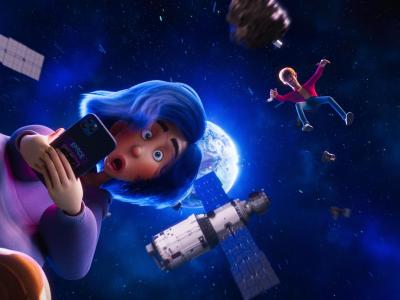
This video with a subtle message came about because Jeff Marx wrote an original song with witty lyrics about addiction to mobile phones. Enchanted by it, Federico Heller and Nigel W. Tierney decided to build an animated short film around it.
“I am a dick, ‘I am a dick… I am addicted to it!”
Jeff Marx is not only a composer but the formidable co-creative of the multiple Tony award winning ‘Avenue Q’, a funny ‘Sesame Street’ spoof with puppets and human actor that explores the dramas of young adults, through the travails of the character ‘Princeton’. After writing the song, Marx and Andrew Hawkins wrote the script which Heller and Tierney shaped it into the film we now see.
Federico Heller was born in Argentina and studied at the University of Buenos Aires and was already working in visual effects when he teamed up with his brother, Germán, to launch their 3DAR film company which is based in Palermo Hollywood Buenos Aires, where else? The studio has acquired a reputation for quality and originality.
Heller’s debut short was ‘Uncanny Valley’ (2015) that examines the consequences of a dystopian future where First Person Shooters have become the new drug for those disillusioned with society. Virtual reality junkies satisfy their violent impulses with online entertainment. Heller questions how technology will affect our lives. This is a tough comment as Heller does not shy away from being frightening, introducing suicidal robots even in a short movie.
Heller’s second film was his first music video based on a song, called Lil Dicky’s ‘Earth’. Lil Dicky (born Andrew Burd in Pennsylvania in 1988) is a popular American rapper, comedian, actor, singer and writer, known for comedy hip- hop and his FX/FXX comedy series TV series ‘Dave’. He attracted widespread attention when his 2013 song Ex-Boyfriend went viral on YouTube. Federico Heller and Nigel Tierney were amazed when, with his charm and outstanding persuasive abilities, Lil Dicky managed to persuade insanely famous people to take part in the film ‘Lil Dicky Earth’ (2019).
“So, ‘Earth’ is this music video by Lil Dicky and he put together all these celebrities for the cause of saving the planet, right? …That was my first collaboration with Nigel, the Earth video got insanely popular, like talking about 500 million views, something like that on YouTube. Fantastic… It’s really quite mind-blowing, isn't it?
The ‘Earth’ crazy ride includes fun creatures from a lazy Koala bear (Ed Sheeran), a zesty Zebra (Ariana Grande), A cheeky monkey (Justin Bieber) to a strong- willed Shetland pony (Katy Perry) to name a few. Leonardo di Caprio appears as himself in an animated format and a large number of other well- known singers and celebrities participate as characters and backing vocals, with Lil Dicky also as himself, being the main character.
Federico Heller: -
“I think with ‘Earth’ one of the things we put in practise was like, how silly can we be? How absurd can we be? For example, there's this camera that goes into the baboon's butt (Justin Bieber is the baboon). So he says, I'm like a man, just less advanced, but my anus is huge! Then the camera goes inside. So suddenly, immediately you're not thinking about climate change, you're thinking about: Wait, I just went into a baboon's butt, right? So I think the challenge, in particularly animation, has this power of exaggerating… of being not serious, but also, yeah, like in animation style, we kind of wanted to present a situation where the character was not also victorious, in the sense that he wasn't a preacher that was telling us, yeah? He was just a helpless guy because we are like that, because actually we don't have much of a solution to the phone situation. Now we're stepping into the new realm of AI and we haven't even solved the previous crisis. The world is… we were completely hacked by social media mentally. And we haven't really overcome that!”
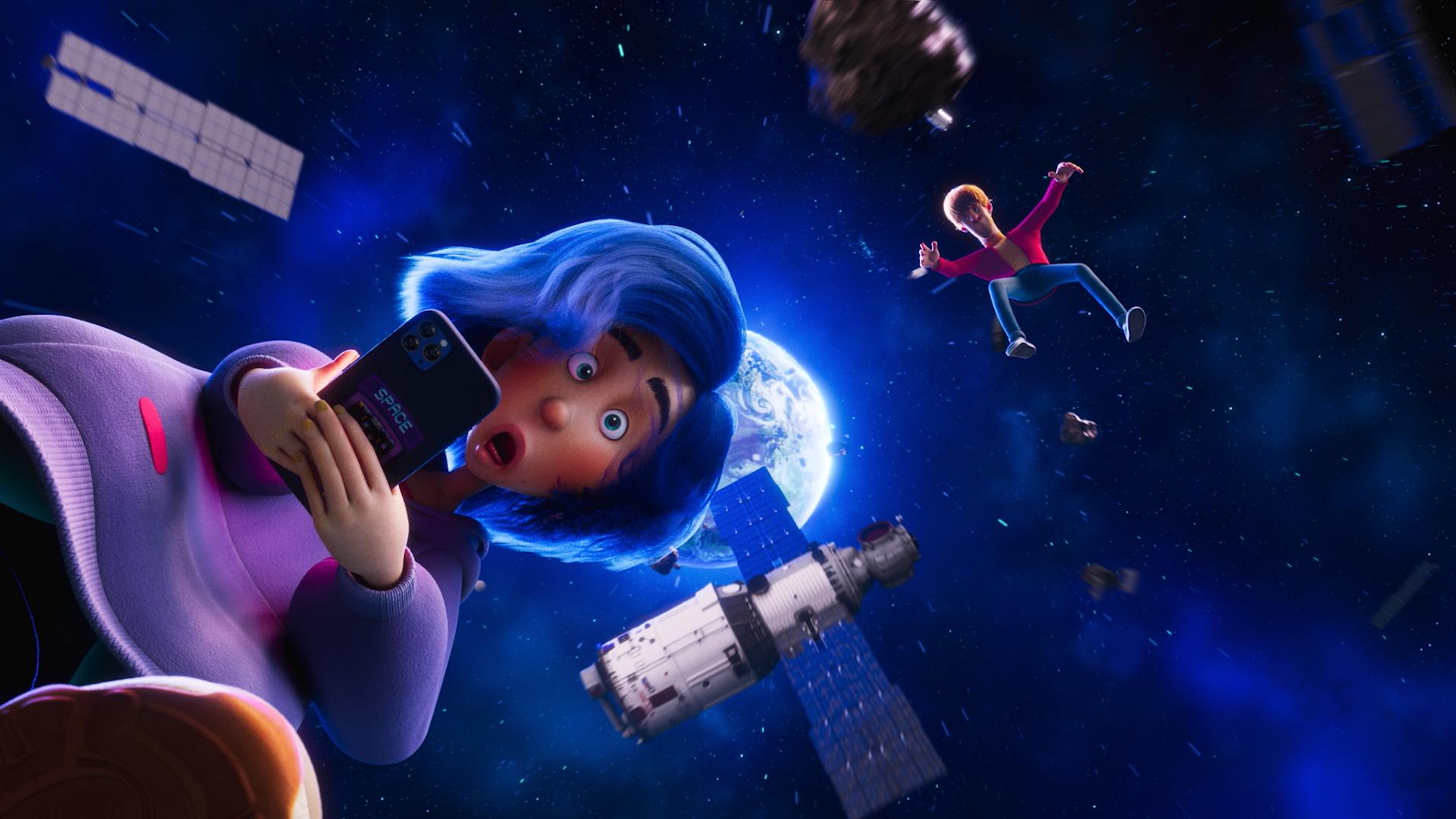
As he points out, Heller and Tierney’s latest film ‘Addicted to it’ is a mad-cap entertaining frolic, full of fun and witty visual jokes, while not shying away from making a sharp critique of the problem of phone addiction all over the world. Characters from all walks of life are depicted: teenagers, kids, older toughies, the runner, Dace himself, and even a pair of twins, but the message is really that anyone and everyone can become addicted: -
“They become willing slaves to technology…”
So, in the end, no one is totally immune. The beautiful scenery is there to remind us of what we are missing along the way, staring at a small screen instead of the vast world around us, so vast it also encompasses space. Other ‘voices’ in the movie come from Dixie D’Amelio, Morgan Jay, Andrew “King Bach” Bachelor and Jeff Marx himself, who is the singer of the song: -
“The endorsement of Mel Brooks has opened up so many paths of people loving us just because we are working with him, but at the same time, uh, you know, like Dixie D'Amelio and some of the other celebrities that are in the project are really helping too, of course. In terms of the characters, we broke it down to archetypes of addiction, right? Like from the fitness guy to the persons messaging all the time with their friends. So, we kind of broke it down into different branches and created characters that were, for us, quite hilarious to match those characteristics. Also, we started adding a lot of random qualities because also you want to make the characters unique on top of that.
We got quite a combination of different characters with the same problem. A little bit of the structure of this short was around that it was like: let's see this problem from every angle and let's iterate more and more into the more, the bigger absurdity that comes there. And that's why it ends up with like a war… a war for attention.”
Will the message prevail? When it comes to Federico Heller’s own children, it is interesting to see how they respond: -
“Well, it's very funny because it is a topic right in my house. I have a teenager, a 13-year-old and an 11-year-old. And when we came back from a screening the other day, the oldest was singing the song. But at the same time, it's not like he agrees with the message. It's funny. He doesn't want to talk about it because he doesn't want to be caught off-guard.
And that's why I think it's so clever, the approach of Jeff, who's such a musical person. He says: OK, maybe, you know, you have people talking and singing this song and having fun with it. But it’s a concept that is somewhere around in your mind because the debate, when we're debating about issues, the debate mode is never the best mode. I run a household, right, with my wife and sometimes, you know, kids don't want to be told what to do or how to think. The moment you start talking to them in that certain mood, they go like: ‘OK’, it's just a blank out, to see how long is he going to talk about this. I find it interesting, videos and art forms. You mentioned ‘Uncanny Valley’, which is not that I have a linear message to say: Hey, virtual reality is going to kill us all or something like that.
There are ways in which you can abide with certain topics, in certain moods. For example, I'm not an expert, but I would guess that if people could be thinking about their own addictions and laughing about it for longer periods of time, that could have an effect that could be really positive. But since every time we think about our addictions or the aspects of our lives that we don't like, we go into these heavy moods that we cannot sustain for long because they're like…well we don't want to feel bad, of course. So I don't know, I think videos and art forms can be useful in that. It's in a way similar to a song where you abide in thought, but without the format of thinking, right? Like you're not going into it, you're not ‘philosophising’.”
Heller’s attempts to control what his children could see on the internet has been a battle every home will recognize: -
“You don't even know what is your fight anymore with this thing, because it’s a tool that shapeshifts from a tool to a vice so quickly. It's like: Oh, let me… what do we need to buy in the supermarket? So that's why we thought of this character, Phoney Bunny, which, which was a bit of a shapeshifter and, and a bit of a phoney, right? So, he's like all cushy on the outside, uh, playful and friendly. So, we chose a bunny because it had all the [right] characteristics. We tried other animals from dogs to cats, to pandas, to snakes. But what was funny about the rabbit was that first of all, they're a very fast animal. Um, and they're all furry on the outside, they consume quickly, they reproduce quickly, like sexually, so there is this creature, moving at a faster pace than you can. It's outsmarting you at every moment. So, for us, it was quite a joyful process with Jeff and Andrew, because they think very musically… Animation is a bit like music because things move to a beat. It has a rhythm. If you have, for example, a power imbalance in an animated scene, it's not like ‘Succession’ where everybody's static- and no, the power imbalance is one person completely over the other. You make fun of it. You exaggerate that. And that lack of subtlety is also part of the toolkit.”
The film is a fantasy around a music video with a very memorable song. It is a fun watch, colourful, creative, and it buzzes with energy. We soar over beautiful mountain ranges, forests, rivers and stunning underwater scenes, with beautifully animated scenes down to the finest detail, be it the stubble on a chin, the fur on Phoney Bunny, or the myriads of colours in a flower, the ability and the animation versatility and techniques displayed are stunning. The filmmakers used Maya as the main software with Houdini for particles. After Effects helped them in the editing as they also were keen not to use AI at all. It begs the question of whether, after Lil Dicky’s ‘Earth’ and now ‘Addicted to it’, these two directors might finally settle their thoughts on creating a feature length movie.
“I cannot say on the record anything regarding this [feature length] project, but I can say, you know, I love longer format animation but it’s tricky in this industry, because a lot of the studios that make the movies are so insular that it's hard for projects to come from other places, but sometimes it happens. The business model of short films is so complicated too because how do you make money with a short film, right? If you do a video game, you can make money, but short films are a weird beast in a way.
Animation for me is not about dreaming, it is about doing. The first programme that I used was called ‘Animator’ and it was like a black- and- white, incredibly poor programme, but it was still running on a Pentium, one of those old PCs. I did an animation of a frog being run down by a car… My imagination was always thinking about characters getting killed and all this thing of exaggerating pain somehow, having characters go through like super[hard]… I cannot stress enough how important it was for me to work with all sorts of clients to get a ridiculous amount of information because your muscle, brain muscle has to be so flexible. When you can collaborate on a big project like that, where you have the freedom to brainstorm and have ideas and be listened to like, like in a project like this, it's a, of course it's a dream, but looking down the road and all it takes is really a lot of open mindedness to get used to being on the craft and get used to not take yourself too seriously and just iterate a lot. It's like, okay, I had a bad idea, another bad idea… another bad idea, but who cares? Like really?
‘Addicted to It’ (2026) won the Best Music Award at the Animayo Gran Canaria 2026 and has qualified for the Oscars, Federico Heller and his co- director Nigel Tierney are delighted with the success of their film at the festivals.
ADDICTED TO IT (2026) directed by FEDERICO HELLER and NIGEL W. TIERNEY
Created by Jeff Marx and Andrew Hawkins/ directed by Nigel Tierney and Federico Heller/ Music and Lyrics by Jeff Marx / Producer: Nigel Tierney/ Head of Production- AD: Lucia Torbbiani / General Producer: Santiago Tereso/ Executive Producers: Jeff Marx. Andrew Hawkins, Nigel Tierney. Germán Heller and Marco Lococo / Lead Storyboard: Erica Villar, Art Director and Visuals: Federico Carlini/ Character Design: Oscar Ramos, Aleksey Baydaku / Concept Artists: Flavio Greco Paglia and Matías Almada / Lighting: Alejandro Turano, Agustín González and Antonella Marello/ Compositor: Alejo Varisto / Animation Supervisor: Andersson Rey / Animation TD: Julieta Mendilaharzu / Song by Jeff Marx and Andrew Hawkins
Cast: Mel Brooks as Phoney Bunny / Jeff Marx as Dace / Dixie D’Amelio as Nina / Morgan Jay as Pee Mime/ Andrew Hawkins as ABZ The Influencer/ also with Andrew ‘King Bach’ Bachelor
Special thanks to Frank Oz among others/ Companies: Have a sleepover Productions / Tierney Corp / Studio 3DAR