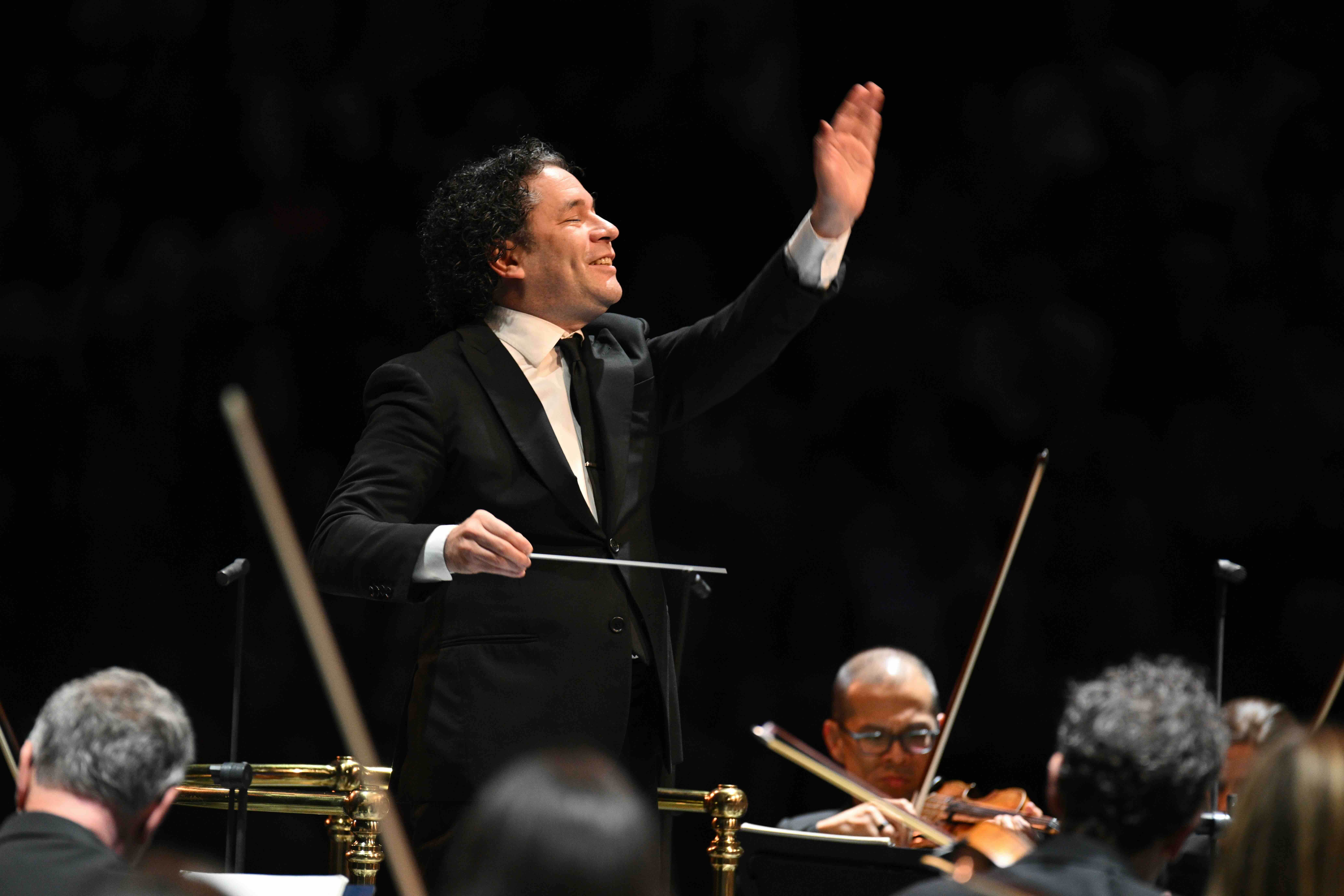
As dusk descended on a scorching summer's evening in Hyde Park, The Royal Albert Hall saw the return of the Los Angeles Philharmonic to the Proms, under the baton of conductor Gustavo Dudamel. You might have seen the Venezuelan star, who is also the Artistic Director of The Simon Bolivar Symphony Orchestra of Venezuela and will shortly to take up a new post as Artistic Director of the New York Phil, recently conducting at the World Cup half-time show or on tour with Coldplay.
The programme chosen by Dudamel was divided into two major works, the first being Beethoven’s majestic Seventh Symphony to which Dudamel brought an energy seldom seen on the podium these days. The more mature version of the boy from Barquisimeto, known to be one of the most musical regions of one of Latin America’s most musical countries, has only enhanced his powers. Dudmel’s unique Latin American roots have added so many resources to a toolkit enriched by experience, on which he draws to unleash his orchestra, bringing out the rhythmic sonority of the work of the great German composer.
Growing up in a musical home with a trombonist father and a singing teacher mother, Dudamel joined Venezuela's El Sistema youth music program at age five, studying the violin and later learning to conduct. In 2007, a 26-year-old Dudamel conducted the Simón Bolivar Youth Orchestra’s debut performance at the Proms in what is now considered one of the greatest Prom performances of all time. The joyous orchestra made up of young Venezuelans, many from the poor backgrounds, brought the house down, as they danced and sang in their signature shell-suits whilst playing the Mambo from Leonard Bernstein’s West Side Story. The British classical music audience had never seen anything like it, not knowing that this of course would be a totally natural for Venezuelan musicians to play classical music, and have the skill to do it to boot.
The performance sent shockwaves through the classical music world and put El Sistema on the global map, duplicated on our countries including Scotland, while Dudamel went on to become one of the world’s greatest living conductors. His charisma and style has brought classical music to a new global generation with performances at the world’s biggest stadiums, as well as concert halls.
Now a frequent visitor to the Proms, his rendition of one of Beethoven’s most well known symphonies confirmed that the hype around Dudamel is well-deserved. Still using such a variety of expression in his body to conduct, Dudamel is ever-mesmering, while the sound he releases from the LA Phil's distinguished musicians is smooth and subtle, rich and elegant, alive and graceful.
The second half of the concert was dedicated to a major work of the contemporary scene by Mexican composer Gabriela Ortiz, Revolución Diamantina (Glitter Revolution), who Dudamel has described as "one of the most talented composers in the world" and a "natural genius." Originally designed to be performed as a ballet, and based on Mexico's 2019 feminist protest movement, the piece transmits the horror of the ongoing persecution of women in Mexico, and in the world as a whole.

The orchestra’s playing did more than justice to a bold work, which uses the full breadth of instrumentation, including ample percussion and vocals, to evoke the composition’s the nightmarish element. The work not only conveys the violence that women endure but crescendoes into a moment of real beauty, before ending on a note of tenderness, representing the aspiration to working together with men to find a way forward.
Wednesday's Prom shows what can be achieved when real opportunity is paired with young talent from diverse backgrounds, rather than institutional box ticking; Dudamel’s championing of young Latin American composers like Ortiz, is another great example of the knock-on effect and of a grassroots system like El Sistema, which catapulted a young Venezuelan conductor onto the global stage. It is possible that, if Dudamel hadn't reached the heights he has, Ortiz may not have been given the chance to showcase her work on Wednesday.
So what next? What LatinoLife would love see at a future Prom is Dudamel conducting works from some of Latin America's great Afro-Latin repertoire for orchestras, such as that of Cuba’s Beny Moré, Arsenio Rodriguez, Chico O’Farrill, Ernesto Duarte or Cachao, as well as Colombia’s Grupo Niche and Guayacán, or Guaco from Venezuela. These constitute some of Latin America's most loved artists and compositions, but much underplayed in European concert halls.
In Latin America, orchestras have always played for audiences to dance. This may be an anathema for European classical music fans, but if we can learn something from the 2007 Venezuelan Prom bombshell, the result didn't go down too badly did it? And while many of Latin America's great composers and arrangers may not be considered classical today, they will no doubt be listened to for generations to come and constitute the classical music of the future. Guaco at the Proms? Now that’s a thought Maestro @gustavodudamel!
See the Prom in full on the BBC iPlayer