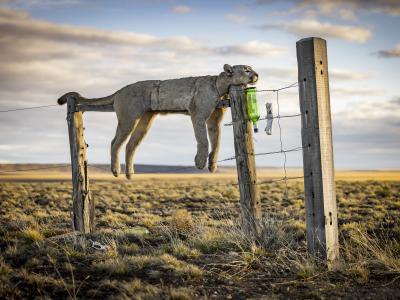
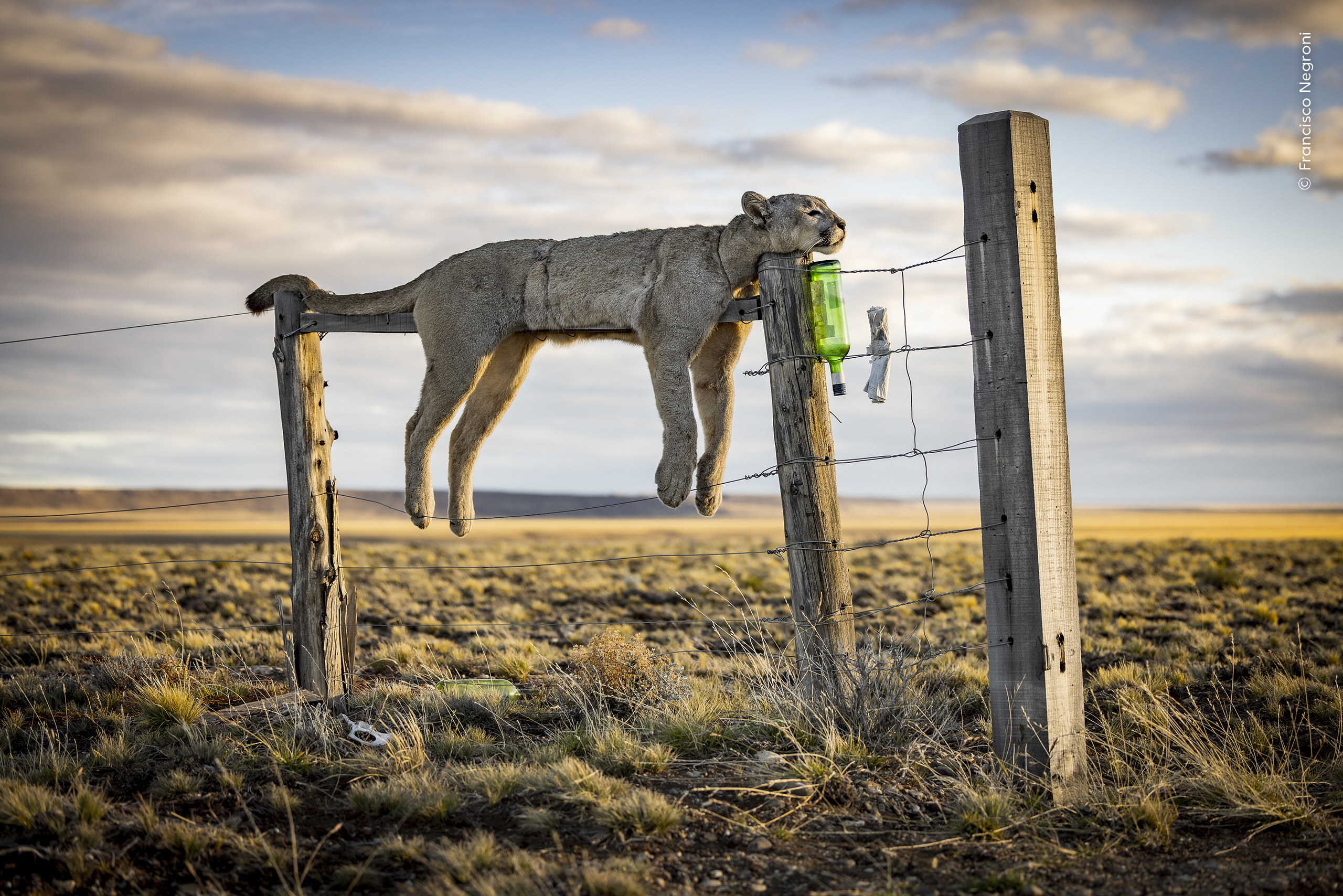
Warning Sign by Francisco Negroni - Winner, Photojournalism
Chilean photographer Francisco Negroni is known internationally as The Volcano Hunter and has dedicated his life to documenting the primal intersection of fire, lightning and stone that makes Latin America’s volcanoes so explosively compelling.
This more reflective - although shocking – photograph taken amid the rugged, windswept beauty of Patagonia, captures a dead puma deliberately tied to a fence as a sort of hunting trophy in Argentina’s Santa Cruz Province, where the hunting of pumas was banned in 2025.
Livestock predation is one of the major causes of human–puma conflict in the region, and the illegal persecution of pumas continues, but the photographer also notes encouragingly that puma numbers are actually on the rise as more landowners see the benefits of keeping pumas alive and promoting eco-tourism initiatives.
Santa Cruz Province has several huge nature parks where you can spot wild pumas, guanacos (wild relatives of the llama), seals, sea lions and penguins, including Parque Nacional Patagonia, and Parque Nacional Los Glaciares, a UNESCO World Heritage site that protects massive ice fields and the famous Perito Moreno Glacier.
Instagram: @negroniphotographer
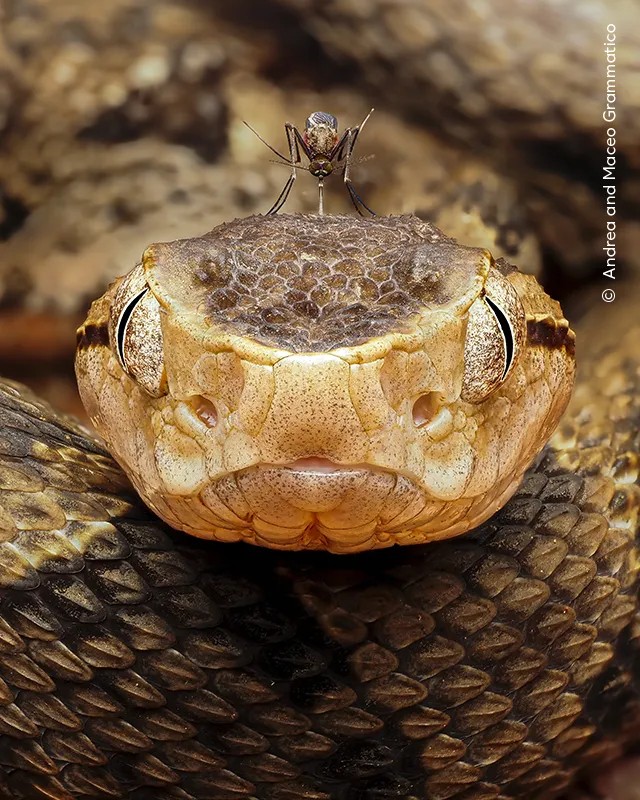
Biting Back by Andrea and Maceo Grammatico – Highly Commended, Animal Portraits
French twins Andrea and Maceo Grammatico offer a snake’s-eye view of a mosquito drinking a venomous viper’s blood in Costa Rica that they captured in Sierpe, the primary gateway to the Osa Peninsula and the starting point for boat trips to Corcovado National Park, one of the most biodiverse places on the planet.
Andrea and Maceo described the image as one of the most demanding focus stacks they have ever created, requiring immense concentration and care, but they didn’t see the mosquito on the fer de lance’s head until they reviewed their photographs later.
The twins study biology and macro photography allows them to look closely at the insects, reptiles and amphibians most people barely notice. They hope to show that even the smallest animals are fascinating and worth conserving.
Instagram: @twins_wild_lens
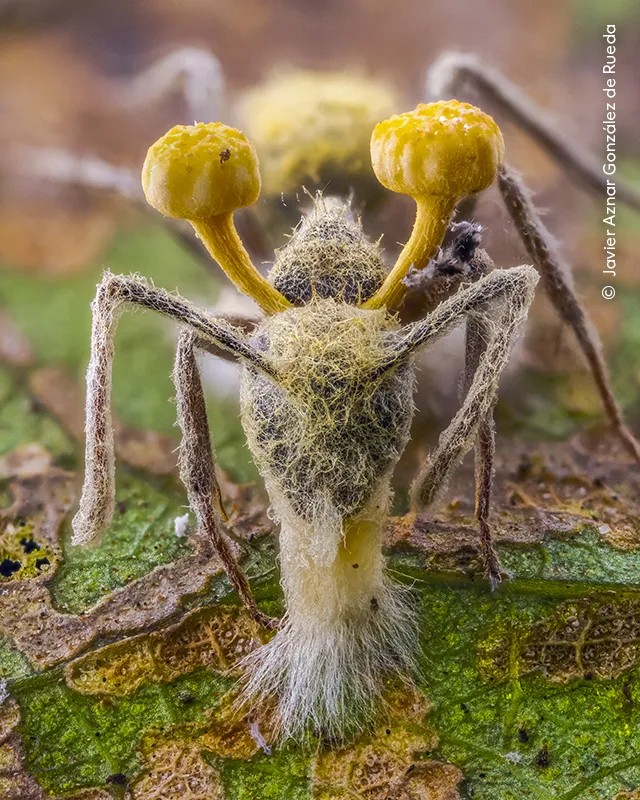
Taking Over by Javier Aznar González de Rueda - Highly Commended, Plants and Fungi
Spanish photographer Javier Aznar González de Rueda’s spectacular zombie-apocalypse macro image shows an ant infected with the spores of a parasitic fungus in the Yasuní National Park in the Ecuadorian Amazon.
Spores of the fungus land on ants or insects foraging in the leaf litter, pierce their hard exoskeleton, and then feed on their soft tissue. They also turn their prey into a zombie, and force it to climb a tree to the right height for the next spores to be released. The two bulbous fruiting bodies on this ant’s thorax will release spores that will infect other ants, repeating the cycle.
Hyper-diverse, the Yasuní National Park is home to more than 600 bird species (including harpy eagles, toucans, macaws and hummingbirds), and over 200 mammal species (including jaguars, giant otters, and 12 monkey species). The park is so intensely packed with insect life that in a single hectare you can find 1,000 species of insects.
A biologist interested in natural history and wildlife conservation, Javier had to improvise a makeshift studio in the rainforest and focus stack 101 images to capture this highly-detailed portrait of the ant, which appears to be simultaneously dead and alive.
Instagram: @javier_aznar_photography
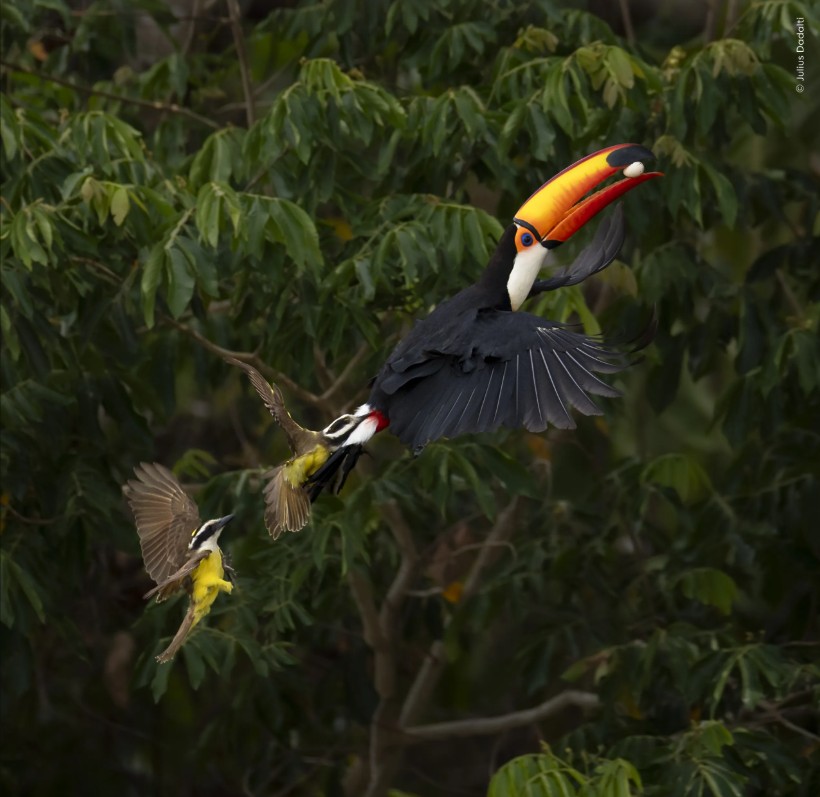
Egg Thief by Julius Dadalti - Behaviour: Highly Commended, Birds
A wildlife expedition leader and nature photographer from Rio de Janeiro, Julius Dadalti hit the jackpot in Brazil’s Pantanal wetlands when he captured this dramatic aerial chase in the upper canopy between a toco toucan with a white egg delicately clutched in its colourful bill and a pair of great kiskadees, whose egg had been snatched.
Julius witnessed the toucan eating eggs at the nest of the great kiskadees before it took off into the forest with the egg, possibly to feed its own chicks.
Toco toucans - the largest toucan species - mostly feed on fruit, but are omnivorous and are known to supplement their diet with insects and the eggs and chicks of other birds when opportunity arises.
The toco’s massive orange-red bill is nearly half of its total body length but is surprisingly light as it is made of keratin, and has a clever hollow structure, which also helps to disperse heat from the bird’s body and keep it cool.
Instagram: @juliusdadalti
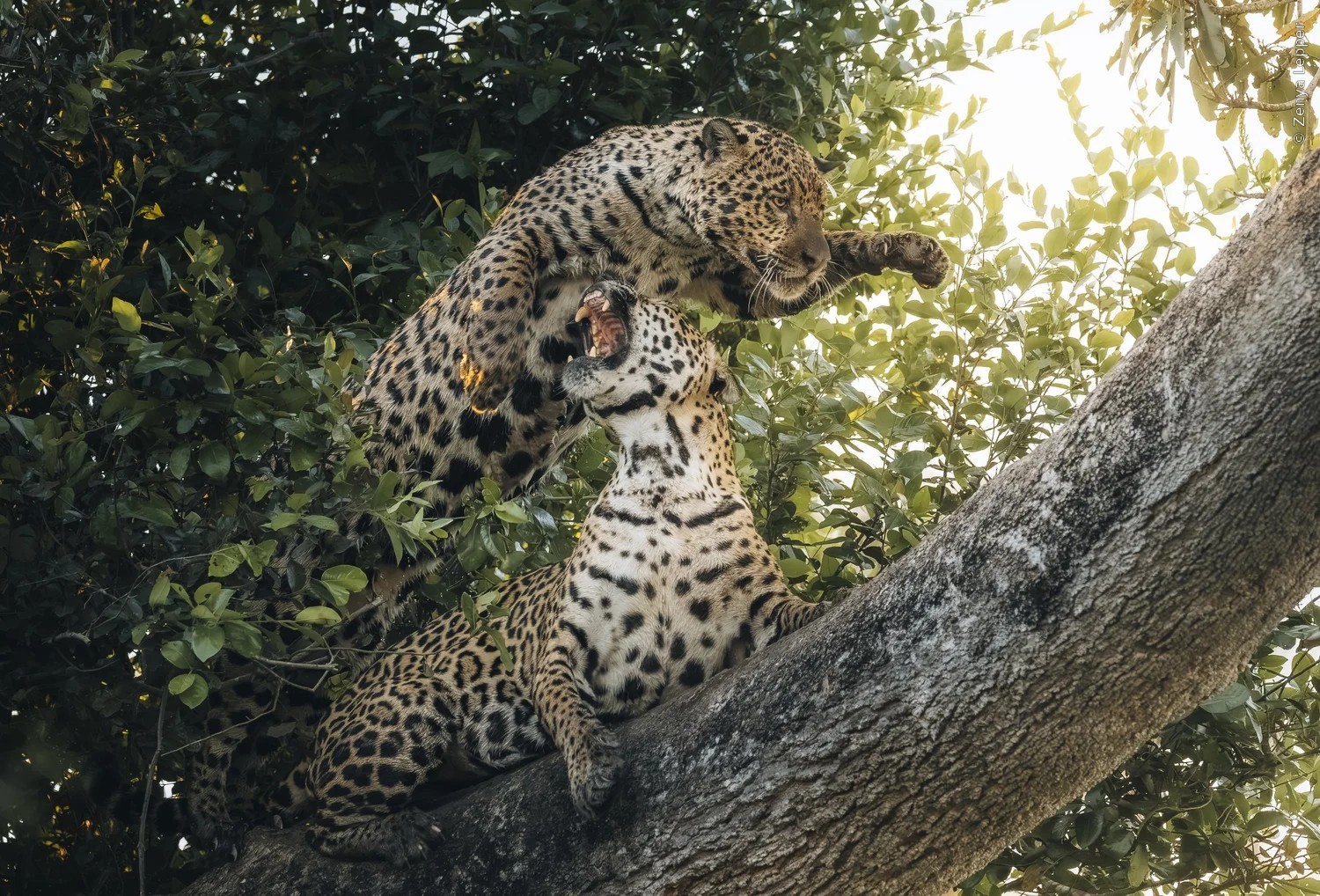
Finding Room by Zenya Lepper - Highly Commended, Behaviour: Mammals
US ballet dancer turned photographer, Zenya Lepper, shares the moment a jaguar duo jostle for position on a tree branch. At the end of a long day exploring Brazil’s vast Pantanal wetlands by boat, Zenya saw these two jaguars on a large branch coming out over the water. After watching them for a while she caught the dramatic moment when the impatient jaguar cub decided to leap over its mother.
The Pantanal spreads across the Brazilian states of Mato Grosso and Mato Grosso do Sul and extends into eastern Bolivia and northeastern Paraguay. It is the largest tropical wetland in the world and the best place in South America to spot jaguars. With a plentiful supply of fish and aquatic reptiles jaguar populations here are roughly double those found elsewhere. When food is abundant, there is little reason to fight over it – even adults have been documented hunting and playing together.
In the Pantanal, the best time to see jaguars and other large mammals like river otters, capybara, and black-and-gold howler monkeys is in the dry season from July to October when days are dry, skies are clear, and the local wildlife congregates around water sources.
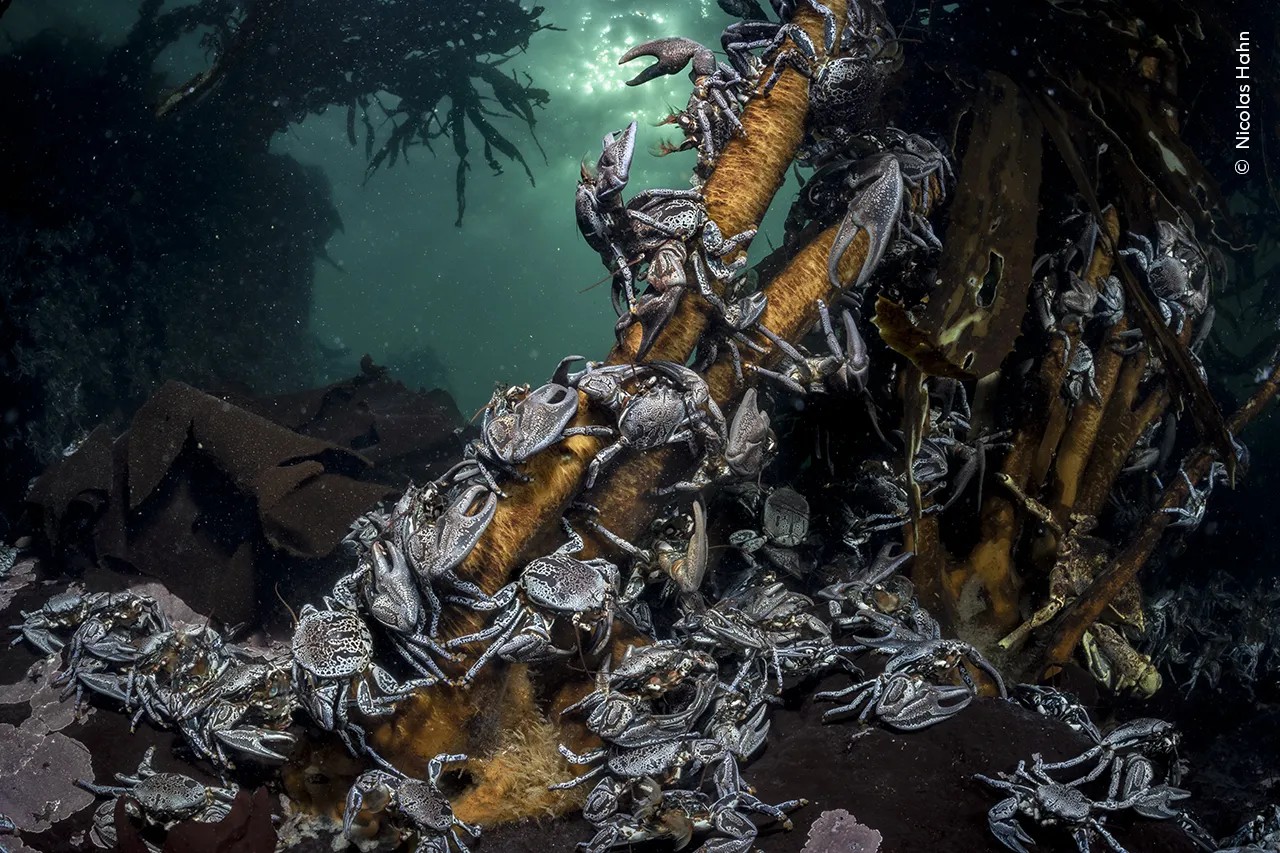
Fine Porcelain by Nicolas Hahn – Highly Commended, Photojournalist Story Award
Argentine photographer Nicolas Hahn takes his camera under the sea in the freezing waters off the coastal village of Caleta Chome in Chile’s Biobío Region to immerse us in the secret world of the little-known porcelain crabs, known locally as changai. More closely related to squat lobster and hermit crabs than true crabs, changai are only 1.5 cm to 2.4 cm wide and are filter feeders that use fanlike mouthparts to catch plankton. They congregate in dense swarms that can reach up to 2,500 individuals per square metre.
Hahn is a diver and freediver who creates stories from South America’s waters to promote marine conservation. In this image entitled Clambering Crabs, he captures dozens of changai as they jostle for position among the stem-like stipes of kelp to reach the best feeding positions in their underwater home.
Close to the Chilean city of Concepción, Caleta Chome is in the Hualpén Peninsula Nature Sanctuary (Santuario de la Naturaleza Península de Hualpén), a vital coastal ecological reserve and eco-tourism hub that is home to Humboldt penguins, South American sea lions, and marine otters (chungungos) all year.
From September to April, the waters off Caleta Chome – site of a former whaling station - are visited by sei whales, fin whales and humpback whales, attracting whale watchers from all over the world.
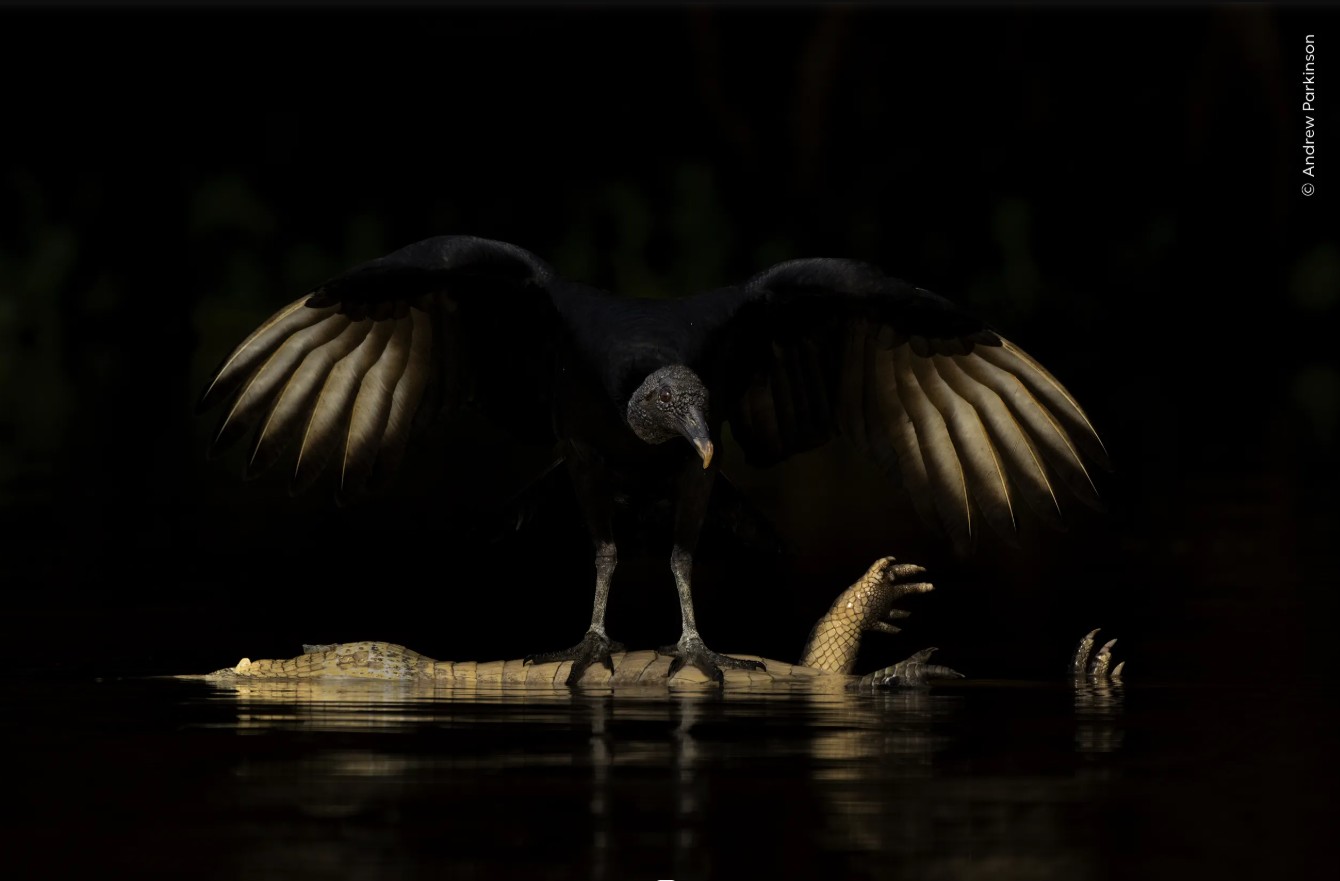
Wings of Darkness by Andy Parkinson - Highly Commended, Animal Portraits
British wildlife photographer and Youtuber Andy Parkinson was leading a photo safari in the Parque Estadual Encontro das Águas (Meeting of the Waters State Park) - a premier wildlife conservation area in the Pantanal wetland region of Mato Grosso in Brazil - when he spied this extraordinary scene of a black vulture standing on the carcass of a yacaré caiman that was floating in the river.
The image was too good to miss so he kept his boat back and used a long telephoto lens to frame what he saw as “the menacing nature” of the vulture. Out of frame, a jaguar was waiting to claim its prize after the vulture flew away.
It was then that Andy noticed “a suspiciously clean, straight wound” on the back of the caiman’s head, possibly caused by a blow from a speeding boat, a problem that can arise when tour operators run their boats too fast when navigating rivers and narrow channels.
Instagram: @andyparkinsonphoto
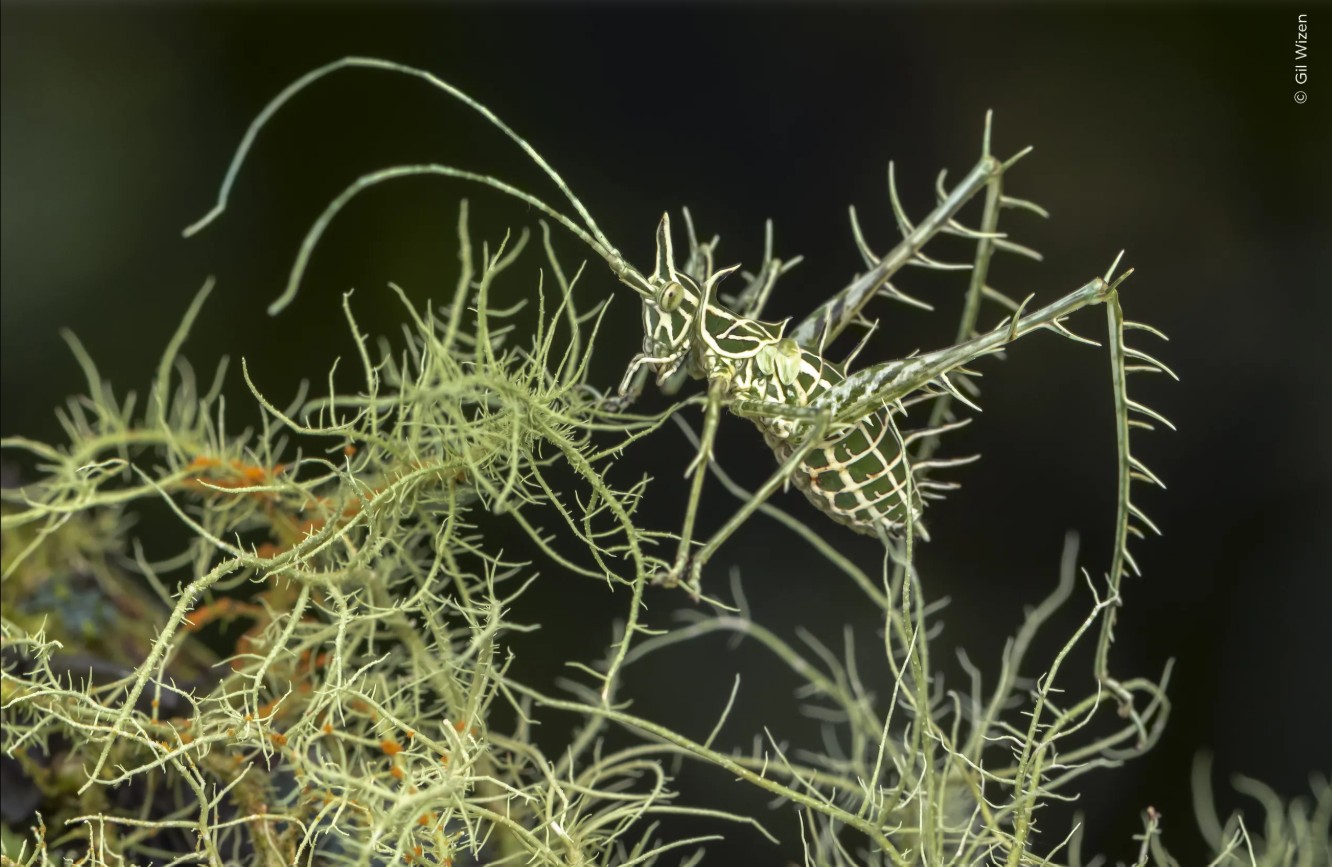
Hidden Dragon by Gil Wizen - Highly Commended, Behaviour: Invertebrates
Gil Wizen had his work cut out trying to capture the beauty of a tiny lichen dragon katydid in Ecuador’s Wildsumaco wildlife sanctuary. A private reserve protecting an intensely biodiverse area of premontane rainforest on the eastern slope of the Andes in Napo Province, Wildsumaco has both a biological station and a birding lodge famous for the number of hummingbird species you can see there. It is also one of the best places to find the rare lichen dragon katydid (Lichenodraculus matti), or “Matt’s little lichen dragon”, which is named after Dr Felix Matt, the German researcher who discovered it in 1997. “Dragon” alludes to the bizarre, spiny armour on its back that perfectly mimics the spiky epiphytic lichen it feeds on and protects it from predators.
Livng on the Ecuadorian Andes mountains that slope down to the Amazon, this little lichen dragon katydid is only 15 millimetres (3/5 of an inch) long and was not easy to find. Distinguishing between this master of camouflage and the lichen in the camera’s viewfinder made it a challenge to photograph, but after a patient wait, Gil was able to spot the katydid when it moved slightly.
The sixty-second Wildlife Photographer of the Year exhibition at the Natural History Museum, London, features 100 of the the winning and highly commended entries to the annual competition and is open until Sunday, 11 July 2027.
Russell Maddicks is a travel writer, author and co-author of guidebooks covering the Balearic Islands, Colombia, Cuba, Ecuador, Guatemala, Mexico, Nicaragua and Venezuela. His latest book Culture Smart! Costa Rica was published in January. Follow him on X and Instagram @LatAmTravelist.