
Even dressed casually in blue jeans and an orange sweatshirt, Yanet carries an air of elegance. Folding away her umbrella, one of the world’s universally awkward acts, she has a dancer's precision. While most London mums look frenetic before heading off to do the school run, Yanet has the poise of someone who has spent a lifetime in motion.
The stories of how a Cuban beauty landing ‘fresh off the boat’ in the midst of London 20 years ago, her wide hazel eyes, glowing cafe con leche skin and luminating darkened salsa clubs, the dance floors in London’s salsa clubs, are now legendary. And 20 years I can still see why.
Yanet arrived on UK shores as part of the touring dance show Lady Salsa and decided not to return home with the dance company.
“I already knew that I didn't want to live in Cuba anymore. It was a great country for training talent in many fields: art, sports, science, medicine. But I was getting frustrated because the country has many restrictions. An artist needs to feed themselves by exchanging ideas with other artists, travelling, discovering new experiences. You can't really have that there.”
However, Yanet still speaks passionately about the tine Caribbean Island and what it gave her.
“I had a very Cuban childhood, a very happy one. There was a lot of contact and games between children. Not so many gadgets and tablets and those things that we have today. I'm glad for it.”
She also credits Cuban culture for instilling her with a passion for dance.
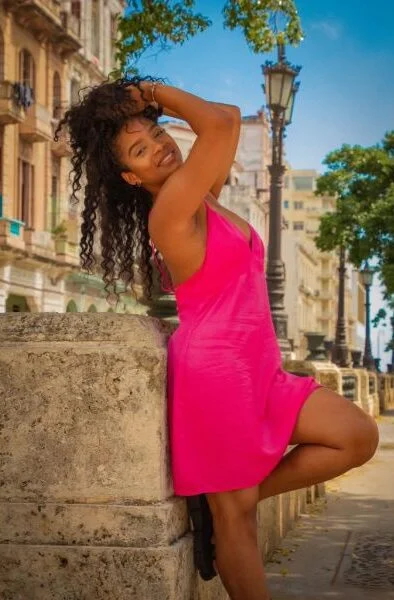
“In Cuba you breathe music and dance. It's part of being Cuban. Nobody in my family is a dancer but all Cubans dance at a party, you know?”
 |  |
Yanet’s parents were both athletes, however, and had very different plans for their daughter.
“My mother is a judoka champion; my father is a football player. And they wanted me to be an athlete. So, I started in gymnastics and hated it with a passion. I spent two years in gymnastics, crying every day, until finally my mother finally asked me, ‘Well, what do you want to do?’ And I said, ‘I want to dance.’”
It was a decision that would shape the rest of her life. At ten years old, Yanet successfully auditioned for Cuba's prestigious National School of Art. Her training in gymnastics and increased flexibility gave her a natural advantage in the audition process.
She went on to spend the next eight years at the school, where mornings were dedicated to academics, and afternoons to dance. The rigorous training system is renowned for producing world-class performers, the likes of Carlos Acosta and Alicia Alonso.
In her final year at the school, Yanet began working alongside her studies. At the time, Cuban students were not permitted to study and work simultaneously.
“I've never liked taking money from my mother, so I danced illegally, in secret. During the day I did all my schoolwork, and when I finished, I went to rehearsals. I danced in a place called La Casa del Mesón, which is the house of the Cuban government. In Havana, at night they do a show with models and dancers, and they close with a live orchestra. I danced there Monday, Tuesday and Wednesday.”
It was one of those performances that unexpectedly changed the course of her life, when she was serendipitously scouted for the Broadway hit Lady Salsa.
“One night, these businessmen from Distanza came to watch the show. From all the dancers they saw that night, they chose me.” She was one of just a handful of dancers selected from her company to travel to Edinburgh to premiere Lady Salsa.
“There are things that, when God puts them in your path, even if they test you, they are still meant for you. I think that was mine.”
After a lengthy visa process, given that she was still a minor when she applied, she arrived in Scotland to perform at the Edinburgh Fringe Festival with Lady Salsa.
“Scotland was very fun. The company all lived in a very big house with lots of rooms and three floors, so we all settled there and became like a family. The Edinburgh Festival is like a walking carnival for a month. I remember it as very funny, almost like a paid vacation. It was all very beautiful, a really beautiful memory.”
The success of Lady Salsa kept the company in Britain far longer than anticipated. Months became years. During that time, Fuentes began to realise she no longer wanted her future to be in Cuba. As her career flourished, she began working hard to find opportunities elsewhere – after finally signing with an agency, the doors were open to work with major international productions.
“I spent a year and a half working full time, from Monday to Saturday, in a theatre, but I didn't want to stay only on the stage. I wanted to do other things, and through meeting people, I realised, I should audition with an agency. I did the auditions, and that's when I started getting the jobs,” says Yanet. “The most difficult process is to get accepted by the agencies. That was the most difficult part, but once you're in their books you don't even have to audition.”
Before long, she found herself performing alongside some of the biggest names in music, from Shakira to Alicia Keys. Yet what is striking is how little emphasis she places on those achievements, or the proximity to celebrity.
“I love my job. I love performing. I also love teaching. I love the cameras. I love being on stage and knowing you have the power to engage people, that they're looking at you, that you're connecting and communicating something. I love that,” she says. “Whether it's in a theatre or somewhere else, it doesn't matter. The passion is all the same.”
The diversity of her career is what she thrives on.
“Thank God my work has been so diverse. I don’t think I could have lasted an eternity in the West End, or with Shakira, or on TV. I don’t like to be in the same place for too long, I get bored. I feel like things become monotonous or it becomes too easy. I like finishing a project and then diving into another that’s completely different. It’s exciting. And I leave each one with so much fondness.”
Leaving Cuba has come at a personal cost, however, and Yanet has always felt a responsibility to make the sacrifice worthwhile.
“I have two main motivations when I dance, the first one was to make it worthwhile being away from my family and to make them proud. That was a huge motivation for me because otherwise I would ask myself: what am I doing here without my mum, my brother, my grandfather, the people I love? Alone, without knowing anyone,” Yanet says. “My second motivation is that I love what I do. I loved it since I was 10 years old, when I decided I wanted to dance.”
Teaching is also a hugely fulfilling experience for Yanet,
“My degree from National School of Arts in Cuba is as a dance teacher and performer. I graduated in both disciplines, which doesn't necessarily mean you'll love both. I think I'm fortunate IN that I love teaching. I like people to leave my class having learned something. I know people don't learn at the same speed or in the same way, but I love it when people to tell me how much they enjoyed it.
“I also love moments when I go to a club in the most remote part of England, and I teach salsa to people who have never been or even heard of Latin America, it’s not their culture, and I see how they absorb, appreciate, and love the music, the culture, the dance – that’s priceless.”
As our conversation turns to the future, Yanet confesses that she’d love to have a dance school. “A very beautiful one.” She clarifies with a smile. “And when I say beautiful, I don't mean aesthetically beautiful. I mean beautiful in its concept of how to develop a dancer.”
The vision she describes resembles the system that shaped her in Cuba, where dance schools encompass both academics and arts. She points to the success of dancers such as Carlos Acosta as evidence of what that model can achieve when talent is properly nurtured. She wants to make that opportunity available to children who might otherwise miss out.
It is important, she says “to have that hunger that comes from overcoming obstacles and achieving things through hard work. When you achieve things because of blood, sweat, and tears, it feels different. I want to give disadvantaged families a chance. You don't know how much talent is lost because someone simply doesn't have the opportunity.”
For someone whose own life changed because a door unexpectedly opened, it feels like a fitting ambition. Her second dream is very different: a successful live-streamed social media show celebrating Latin culture through food, fashion and dance, “the kind of show that reaches every corner of the earth”. Yanet is passionate about sharing her culture - something she appreciates about festivals like LatinoLife in the Park is how they contribute to platforming Latin culture in the UK.
“I’ve been involved with LatinoLife pretty much since it began. Each year has been special in its own way,” she says. “Obviously the most memorable was 2023, when it took place right bin the middle of the worst storm of the year. I had mud up right up to my knees, I could hardly walk. It was still so much fun though!”

More than twenty years after arriving in Britain for what was supposed to be a temporary engagement, Yanet has built a life through dance, determined to make every sacrifice worthwhile and give it back to others along the way.
LatinoLife in the Park takes place on Sunday 19th July www.latinolifeinthepark.com