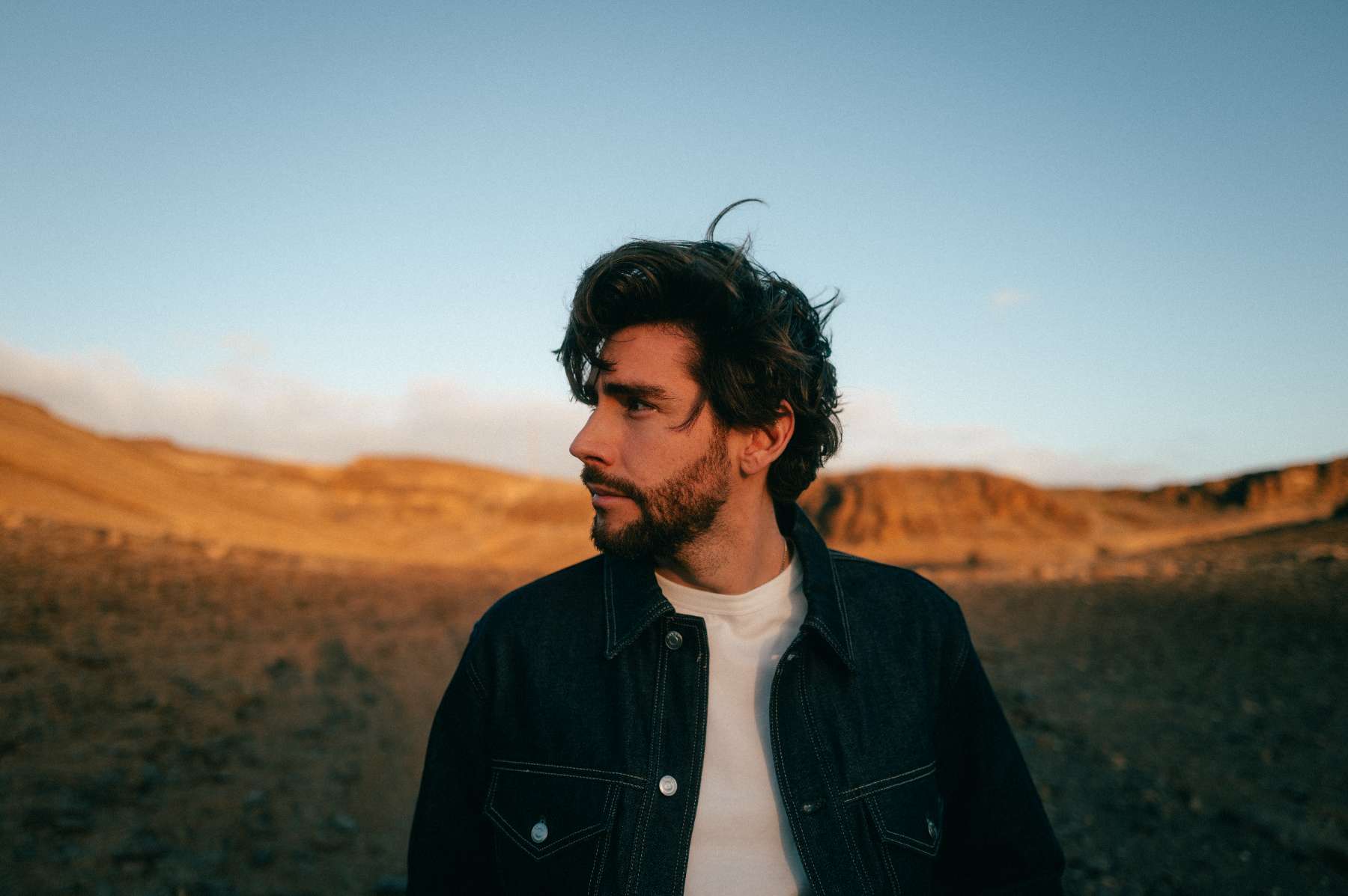
The first thing I notice about Alvaro Soler is his calmness. The kind that comes from someone who has lived through a whirlwind and learned how to walk through life at his own pace. I remember first being introduced to him back in 2015 when the single El Mismo Sol launched him into stardom in Europe and Latin America. When I hear it now, I still get hit by a nostalgia that feels like stepping back into the summer months of my teenage years.
Ten years later, Alvaro sits across from me through a screen, relaxed and steady as we settle in to talk about his journey. When you look into an artist’s early life, you often find a thread that quietly explains who they later become. In Soler’s case, that thread stretches across continents.
Alvaro spent his childhood moving between Barcelona, Tokyo and Berlin, shifting between cultures and languages long before he launched into the music industry. By his teens, Alvaro spoke six languages. When I ask whether growing up between so many worlds ever made him feel out of place, his expression shifts into something soft and thoughtful.
“I was laughed at in school alot,” he says. “I felt like I did not belong anywhere. Music was where I felt safe and understood.”
The sensitivity in what he says carries weight. So many of our readers have probably known that sinking feeling of not quite belonging whilst growing up in a different country.
"For me, music was a nice place to be in…to feel comforable and safe. I think we all need to find that place for us and also be with each other," he adds. "That is why my family is very united."
It is his way of saying that belonging is not always a location. Sometimes it lives in what you love and in the people who anchor you while you figure everything else out.
This leads me to want to know the boy Alvaro was at the very beginning. I ask him what life looked like around the time he released his first album Eterno Agosto (Eternal August) in 2015, long before he knew one of its songs would go double platinum.
“I was a very shy boy, very introverted,” he informs me. “I played the keyboard with my band, and my brother was the lead singer. I wasn’t used to being in the front. At first, I didn’t know what to do with my hands if I didn’t have the protection of an instrument.”
I can almost picture Alvaro then, the young pretty face hiding behind a keyboard during his time in the band ‘Urban Lights,’ unaware that a seismic shift was coming. So I ask whether his overnight rise ever felt real, or if it bypassed him completely.
“Everything happened so quickly,” he says. “When I released El Mismo Sol, it went to number one in a month, and then Jennifer Lopez called. I was just in my room, and suddenly I was here with all these amazing people and sharing stages with the greats of the time... I think I didn’t even have time to process it then”.
Now, at 34, Alvaro has lived so many different lives. From being a judge on The Voice Kids to performing at large festivals, Alvaro’s buckets of experience have now taught him how to process and also express himself better through his new music.
When conversation turns to his new album El Camino, he sits up a little, almost subconsciously. Even having a screen between us, his closeness to this album feels unmistakable. So how different was his creative process this time around?
“This is an album to listen to from number one to number sixteen,” he replies. “It is a whole [linear] story.”
As he describes the process, it feels like he is guiding me through a long corridor of ideas, each door a different sound and a different moment in his life. “I was trying out different things…even with cassette tapes, to sort out what belongs,” he explains.
He even tells me he wrote around fifty songs before cutting them down. As someone who can barely throw away an old receipt, I have to ask if it was hard to part with so many songs.
“It was really hard and really tough to choose the songs because I had many, many songs,” he explains. “There is a moment where you have to choose... and I was like, yeah [to the song], but it just doesn’t fit in the concept.”
When, in a pivotal moment, he realised what the album was meant to be called, he says, everything immediately clicked.
“The moment I knew El Camino was going to be the title, then I knew what I wanted to do. From then on it only took me a year.”
Hearing that surprises me. After the tapes, the experiments, the fifty songs, the fact that the final stretch only took a year feels almost unreal.
Hearing the album for the first time, my curiosity was piqued by Distancia (great song by the way). I found myself wondering about the different instruments, so I had to ask what they were. As soon as the question left my mouth, Alvaro’s face lit up.
“I went to this private collection of very old instruments,” he told me. “There were Indonesian drums hanging from the ceiling, very old, like eight hundred years old.”
There is one instrument Alvaro cannot get over: “This three-metre drum that is hollow from the inside…I would play it while it was suspended because if it is not suspended it has no sound.” He laughs, still slightly amazed. “It was crazy.”
He moves on to another instrument…. “A Chinese string instrument. The last time it was tuned was 1996 and it was still in tune.” He laughs.. “Old instruments have many stories to tell.”
While left slightly bewildered at the thought that I’ve never met a person more enthused by old instruments, we continue through the album. Apagame, he says “talks about my struggles with social media, between the real world and the digital world and how I struggle between both worlds.”
Then comes his song Artificial: “Sometimes I thought wow, this is a bit weird and alot of people asked me ‘What were you thinking’,” he smiles. “The lyrics talk about fear and how I sometimes create these castles of fear which do not really exist. I wanted the song to show a positive outcome.”
Curious about how these songs took shape, I ask him what tends to come first in the studio. Is it the lyric, the melody or the feeling? He thinks for a moment before answering. “Sometimes I have a lyric that I write down on my phone,” he says. “Then I bring it back when I am in the studio and start with that lyric and try to figure out some chords to put on.”
But he admits, “Mostly I think what I love is feeling inspired by sounds and by instruments.” Listening to him, it becomes clear that for Soler, the melody definitely comes first.
When I ask how he celebrated the moment he finally finished everything, I half-expect a story about champagne showers. Instead, he gives me a grin “We did a celebration in Barcelona with my friends and family. I chose a restaurant I love with a beautiful rooftop. The whole day was perfect and then exactly in that hour it started raining heavily,” he laughs, shaking his head at the memory. “But we still had a great time.”
His voice warms as he talks about the people closest to him. He shares with me one of his favourite traditions, something he has carried through every album. “I bring all my friends and family to the studio when every song is almost finished. We stand around one microphone and sing together. It always feels like a big moment.” There is something tender in the way he talks about it, letting the people who shaped him live inside the music too.
Before we wrap up, I ask him to describe EL Camino in one sentence. He pauses for the first time in our interview.
“It is the most personal album that I have written until today,” Alvaro says. He then hesitates before clarifying: “It includes the death of my grandfather but also the birth of my daughter and things I never shared before. It comes from the heart. It is unpredictable. It is fun.”
And then he concludes “Just listen and have a good time.”
And that is exactly what El Camino feels like. A slow exhale. A journey traced from years of growth. A reminder that we all deserve a good time. Alvaro Soler walked his path, and now he invites us to walk a little of it with him.